Reviewed · GUIDED
Marrakech: Bicycle Tour with a Local Guide
Marrakech is easier to understand from a bicycle than from a taxi window. In three hours, you ride from the modern districts of Gueliz and Hivernage to the red walls, souks, Kasbah, and Medina, with a local guide steering you through streets that can be confusing on foot. Ziad, Salma, Tarik, Miriam, and Hanan are among the guides praised for clear explanations, humor, and steady help in traffic.
I like this tour for two strong reasons: it gives you a quick mental map of Marrakech, and it takes you into ordinary working streets where you may see bread being made or mosaics taking shape. The main drawback is the cycling itself. Traffic can be intense, and the Medina is not a calm place for a leisurely bicycle ride. You need to ride confidently, stay close to the guide, and accept a few hair-raising crossings.
Key points to know before you ride
- Three hours covers old and new Marrakech: You see Gueliz, Hivernage, the Medina, Kasbah, major monuments, and the city walls.
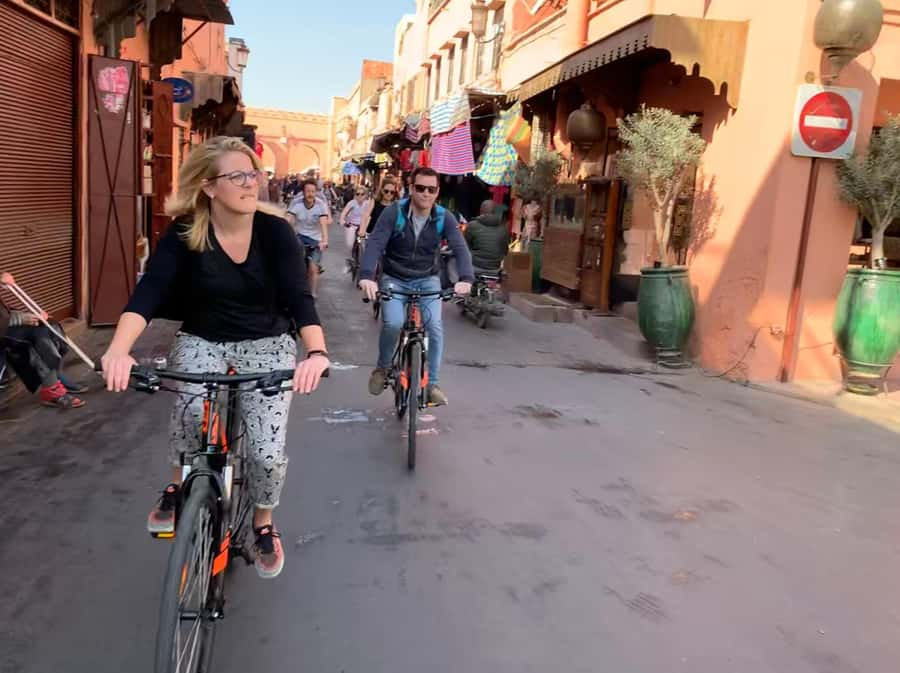
- The Medina ride is the real adventure: Expect narrow lanes shared with pedestrians, scooters, donkey carts, horse carriages, and other bicycles.
- Guides make the difference: Ziad, Salma, Tarik, Miriam, and several others receive praise for local insight and calm traffic guidance.
- It is useful on your first day: The route helps you recognize streets and districts before you explore them alone.
- Bring your own small backpack and water: The bikes do not have baskets, and drinks are not included.
- Ask about safety equipment: Some riders report using helmets, while others say helmets were not offered.
Why a bicycle helps you understand Marrakech
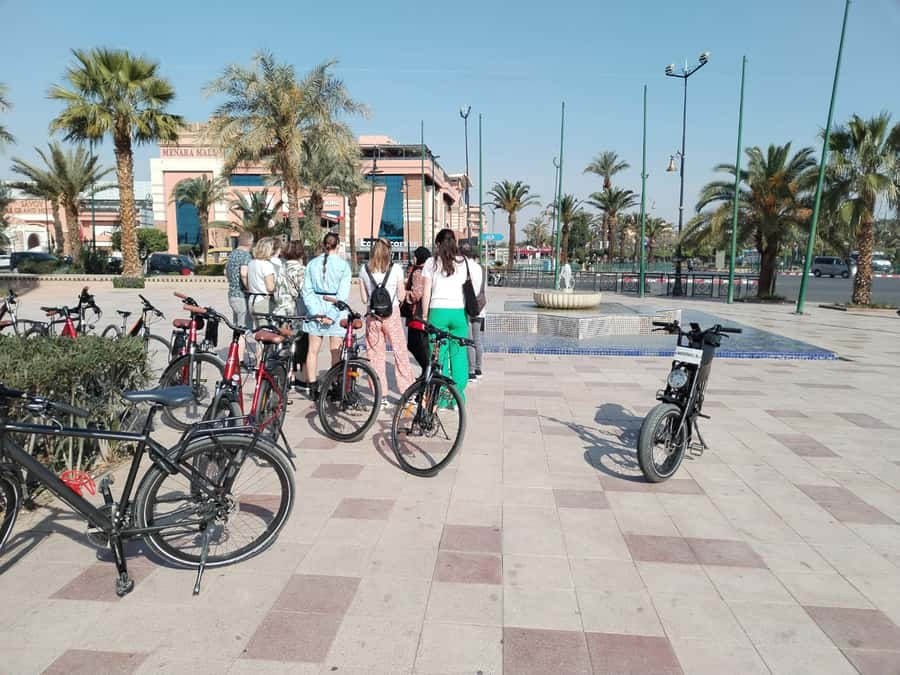
Marrakech is a city of sharp contrasts. One minute you are beside the broad avenues of Gueliz, with its newer buildings and shops. Soon you are riding beside the old red-clay walls, then turning into lanes where the city feels much older and more intimate.
Walking gives you time to notice details, but it can take a while to cover ground. A taxi gets you across town quickly but misses the small streets. A bicycle sits between the two: you cover a useful distance, stop often, and remain close to street life.
I especially like this as an early activity in your stay. Several riders used it to get their bearings, then returned to places they had noticed along the route. After three hours, the Medina may still be confusing, but it will feel less like a maze. You will have a clearer sense of where the Koutoubia Mosque, Jemaa el Fnaa, Kasbah, newer districts, and city walls sit in relation to one another.
The pace also gives you a feel for Marrakech beyond its postcard sights. You may pass workshops, food producers, small parks, and side streets that you would not seek out on your own. Some tours have stopped at a traditional bakery to see bread being made, while others have included a mosaic workshop, a spice shop, or a place showing how argan oil is produced. These stops add meaning to the ride, but they are not guaranteed as a fixed part of every departure.
A few more Marrakech days worth comparing
- Marrakech: Quad Bike Tour to Palm Oasis and Jbilat Desert
★ 4.8 · 11,831 reviews - Marrakesh: Majorelle Garden Entry Tickets
★ 4.5 · 9,651 reviews - Marrakech Quad Bike Experience: Desert and Palmeraie
★ 4.5 · 9,509 reviews
Starting in Gueliz and Hivernage
The meeting point is the Morocco Toubkal Adventure shop at 22 Rue Oum Errabia. The return point is listed as either Atlas Sport Bike Shop or Toubkal Adventure and biking in Marrakech, so check the exact meeting and finish details before you set out.
The ride includes about 30 minutes in Gueliz. This newer part of Marrakech gives you a useful contrast with the old city. Broad roads and more modern buildings make it easier to settle onto the bike before you face the tighter streets of the Medina.
Hivernage is also part of the wider city picture. The route does not treat Marrakech as one single old town. Instead, you see how the modern districts sit beside the historic core, which helps explain the city’s layout and daily rhythm.
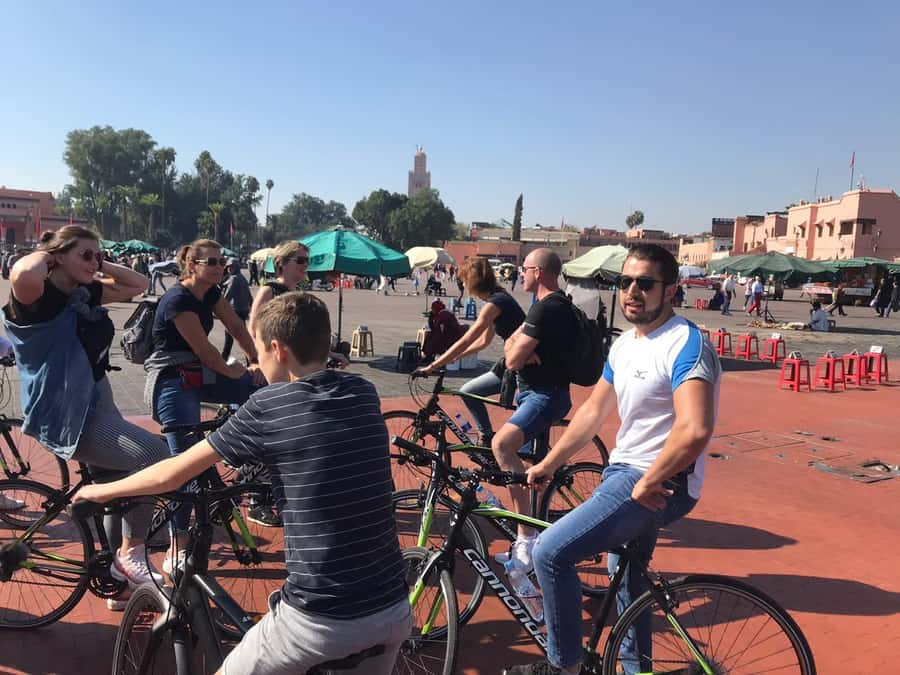
The bikes have been described as easy to ride and well maintained, with some riders mentioning Cannondale bikes. You should still take a moment to adjust the saddle and check that the brakes feel right. This is not a technical cycling excursion, but you will want a bike that fits before entering traffic.
Koutoubia Mosque and the gardens behind it
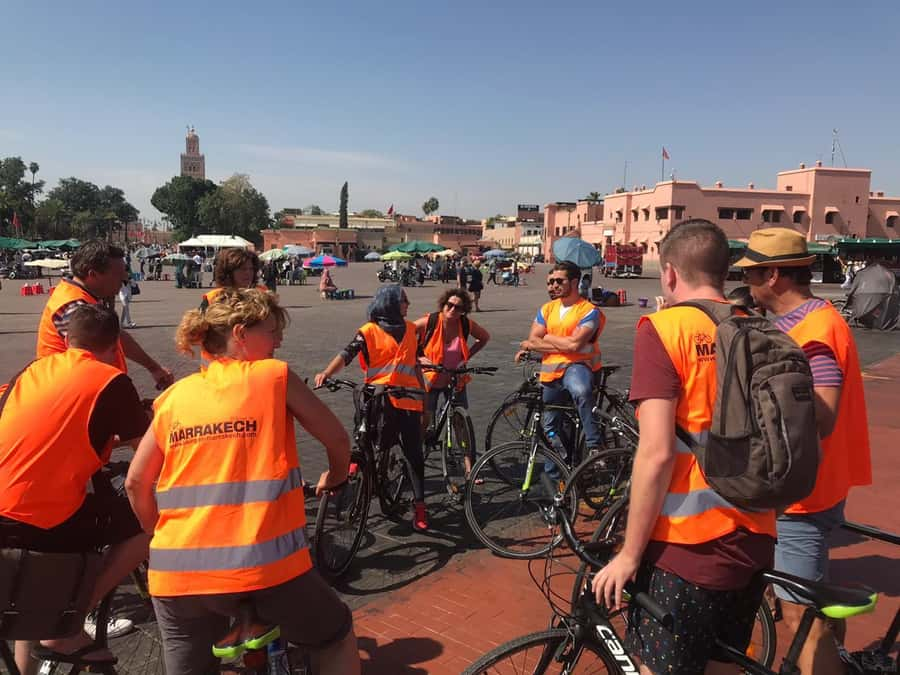
The Koutoubia Mosque is one of Marrakech’s clearest reference points. Its minaret rises above the surrounding city, and the gardens behind the mosque offer a more open place to pause after the tighter streets.
The tour does not include entrance fees to historic monuments, and the Koutoubia Mosque is not presented as an interior visit. Think of this stop as an exterior landmark and orientation point. Your guide can help place the mosque within the wider city, while you get time for photos and a short rest.
This is one reason the bicycle works well here. You can reach the mosque, stop without spending a long time walking across town, and then continue toward the southern districts. Keep in mind that the tour is designed as a first look rather than a detailed monument visit. If a palace or tomb catches your attention, you may want to return later with more time.
Saadian Tombs and the Kasbah
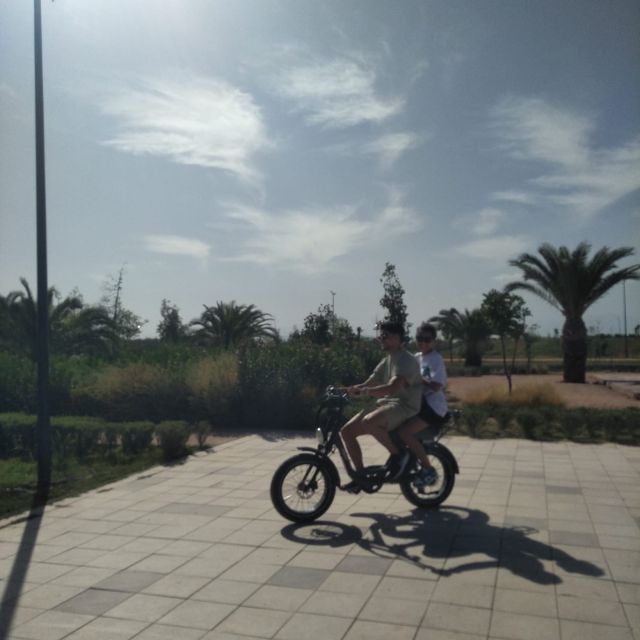
The route continues toward the Kasbah and the area of the Saadian Tombs. The Kasbah has a different feel from the main square and central souks. Its lanes are still active, but the route gives you a closer look at a historic neighborhood rather than only the city’s headline sights.
The Saadian Tombs are an important stop, but entrance is not included. You may pass the site or pause outside, depending on the group and the guide’s timing. If you want to go inside, plan to return separately and pay the admission fee yourself.
The Kasbah section is also where the ride may begin to feel more demanding. Streets can narrow, and you may share the road with pedestrians, scooters, carts, and other bikes. A guide such as Tarik or Ziad can make this easier by choosing a line through the traffic and giving instructions at busy points.
You should not expect long historical talks at every stop. On a bicycle, the group needs to keep moving, and it may be hard to listen while riding single file. The best guides give short explanations at safe stopping points, then let you watch the city as you move.
A completely different kind of day in Marrakech:
- Marrakech: Balloon Flight, Berber Breakfast & Certificate
★ 4.8 · 8,164 reviews - Marrakesh: Desert & Mountain Tour with Camel Ride & Lunch
★ 4.8 · 7,513 reviews - Marrakesh: Early Morning 40-Minute Balloon Flight
★ 4.8 · 6,533 reviews - Marrakech: Majorelle Garden, YSL, and Berber Museum Entry
★ 4.6 · 5,168 reviews
Bahia Palace and the southern Medina
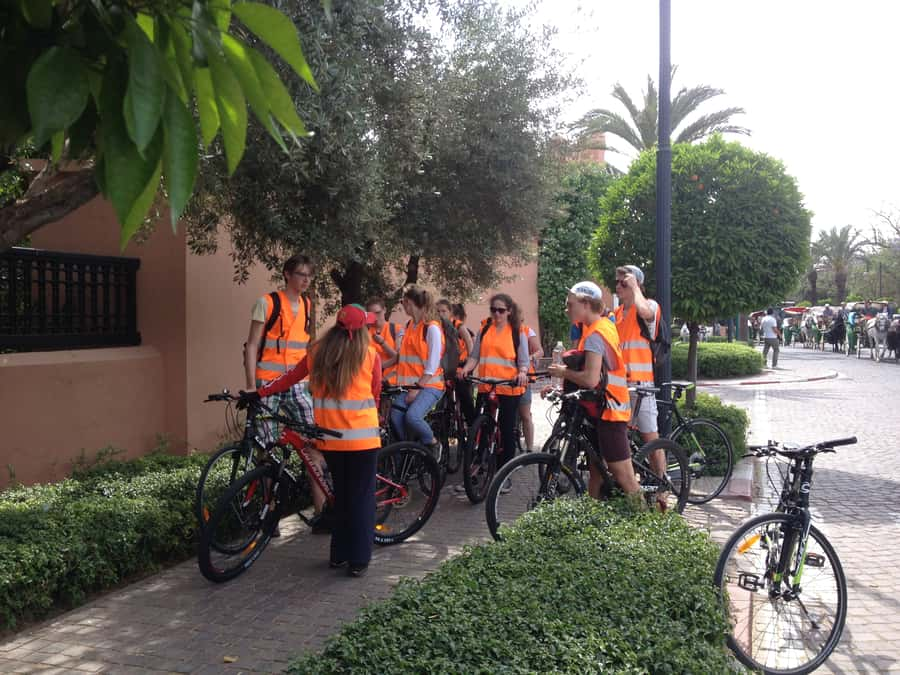
Bahia Palace adds another major landmark to the route. Like the Saadian Tombs, its entrance fee is not included, so the bicycle tour is best seen as a survey of the area rather than a full palace visit.
The value here is not simply ticking off another name. The route shows you how the palace, Kasbah, craft streets, and residential lanes fit together. You also get a chance to note places worth revisiting on foot. A three-hour cycle tour cannot replace time inside Bahia Palace, but it can help you decide where to spend that time later.
The southern Medina is one of the more memorable parts of the ride. Its narrow alleys bring you close to everyday work. You might see a bread maker preparing loaves for local households, artisans working on mosaic pieces, or small workshops operating beside the street. Those moments give the tour more character than a route limited to monuments.
I would treat any craft or food stop as a welcome bonus, not a promise. The fixed route includes the main districts and sights, while the exact pauses can vary with traffic, group pace, and the guide.
Jemaa el Fnaa and the Medina lanes
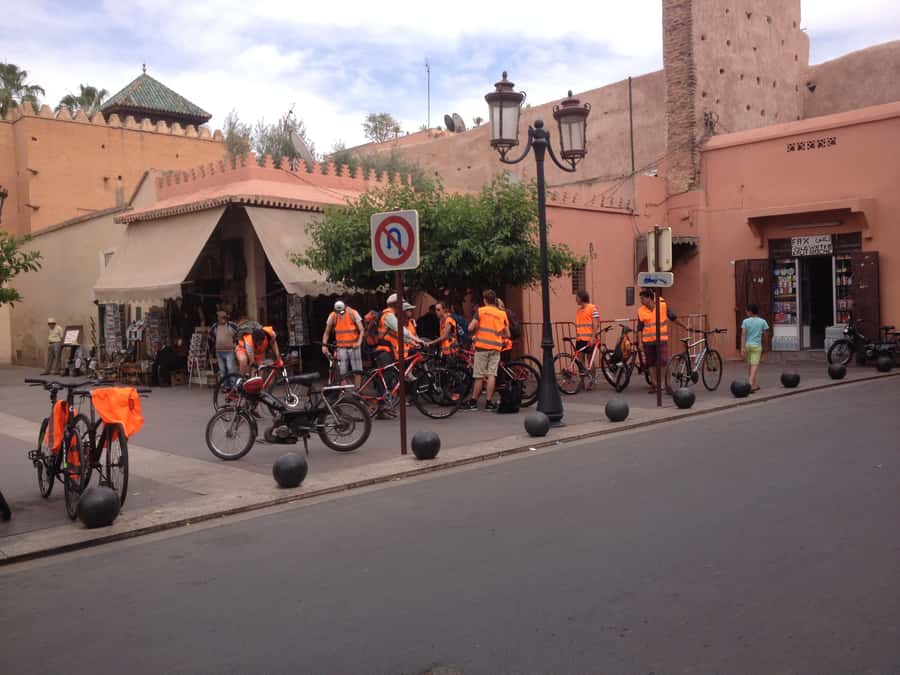
The route includes Jemaa el Fnaa, Marrakech’s famous central square. This is a natural point to pause, take photos, and understand how the square connects the souks, Koutoubia, and surrounding streets.
The final approach through the Medina is the part you need to take most seriously. Riding here can be thrilling, but it is not gentle sightseeing. You may meet scooters coming from different directions, people crossing without much warning, donkey carts, horse carriages, tour buses, and other cyclists.
A few practical rules help:
- Stay close enough to see the guide’s signals.
- Do not stop suddenly in a narrow lane.
- Follow the guide through intersections rather than choosing your own route.
- Keep your pace controlled, even if others move quickly.
- Tell the guide early if you feel nervous or need a slower pace.
The group can become spread out in tight streets. One rider reported that a group of about 14 people had trouble staying together, especially at intersections and with a child in the group. A smaller group will usually feel easier to manage, but the size can vary. Ask the operator about the expected group size if this matters to you.
The tour is not suitable for anyone who cannot ride a bike. It is also a poor match if traffic makes you freeze. You do not need to be a racing cyclist, but you should be comfortable starting, stopping, steering, and holding your line around other road users.
What the guides add to the experience
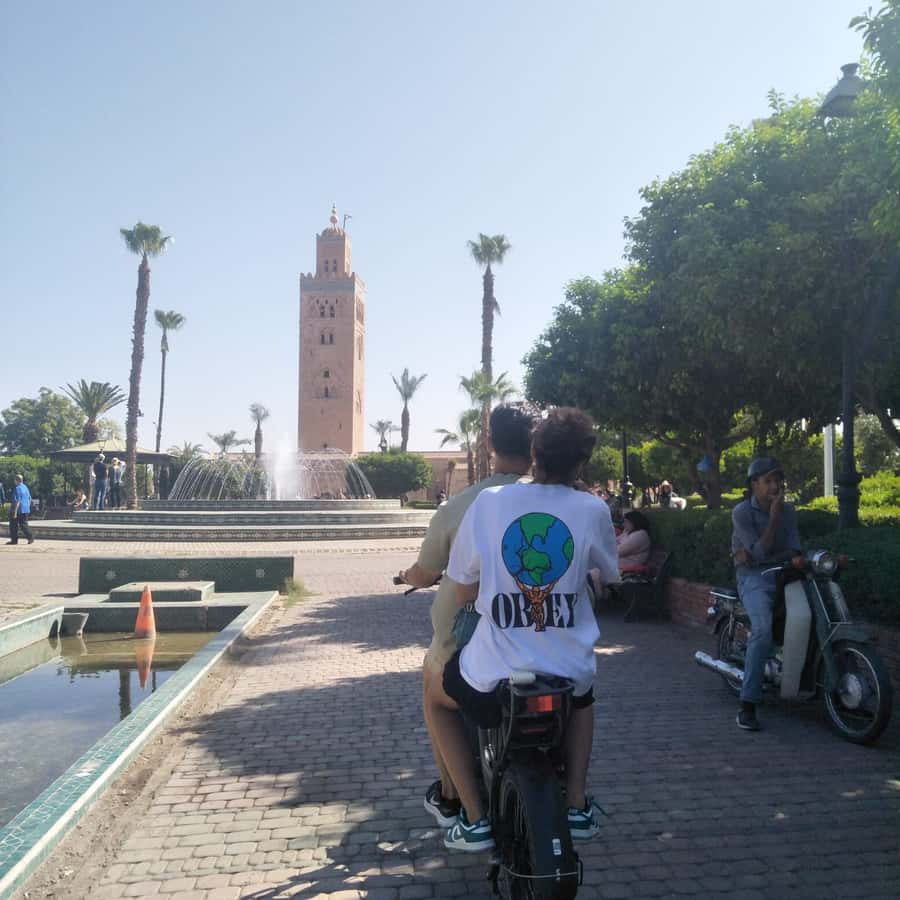
The strongest part of this tour is the human guidance. Ziad is repeatedly praised for being warm, funny, and well informed, while Salma is noted for combining humor with clear local insight. Tarik has helped riders stay safe in hectic traffic, and Miriam has been praised for showing both the old and new sides of Marrakech.
Guides have also offered useful advice about food, money exchange, restaurants, and places to return to. Some have helped with Moroccan Arabic pronunciation. That sort of practical conversation can be as useful as a formal explanation of a monument.
The guiding style may vary. Some riders found the historical detail just right, while others wanted more depth. Do not expect a lecture at every stop. Much of the ride happens while you are moving, and busy streets make long explanations impractical.
The best way to use the guide is to ask questions during stops. Ask where to return for a longer visit, how to recognize genuine argan oil, which areas are easiest to explore on foot, or what local custom you are seeing. The guides appear most useful when you treat the tour as a conversation rather than a recorded history lesson.
Traffic, helmets, clothing, and weather
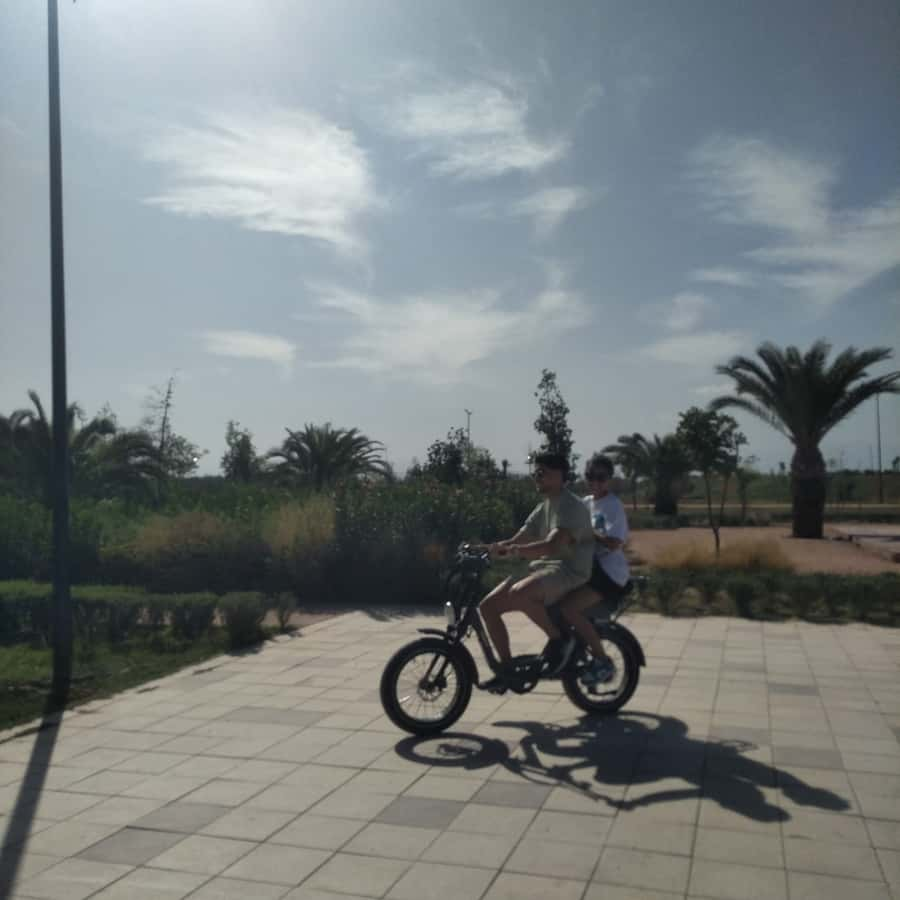
The traffic is the central practical issue. Several riders describe the route as exciting but nerve-testing, particularly in the Medina and at large intersections. Others say they quickly adjusted once they stayed close to the guide.
The experience provider does not list helmets as included. Some riders report that helmets were available or used, while others say none were offered. Ask directly at the shop before departure. The same applies to bike bells, since one rider wished for one in crowded streets.
Wear practical clothing. Short skirts are not allowed, and comfortable trousers or longer shorts make more sense on a bicycle. You should also wear shoes that stay secure on the pedals.
Morning conditions matter. From November 1 through March 31, the morning tour starts at 10:00 AM, with a 9:45 AM meeting time. Winter mornings can be chilly, so bring a layer that you can remove later.
The bikes have no baskets. Bring a small backpack for water, a light jacket, sunscreen, and personal items. Be careful not to carry a loose bag that could interfere with steering.
Is three hours and $34 a good value?
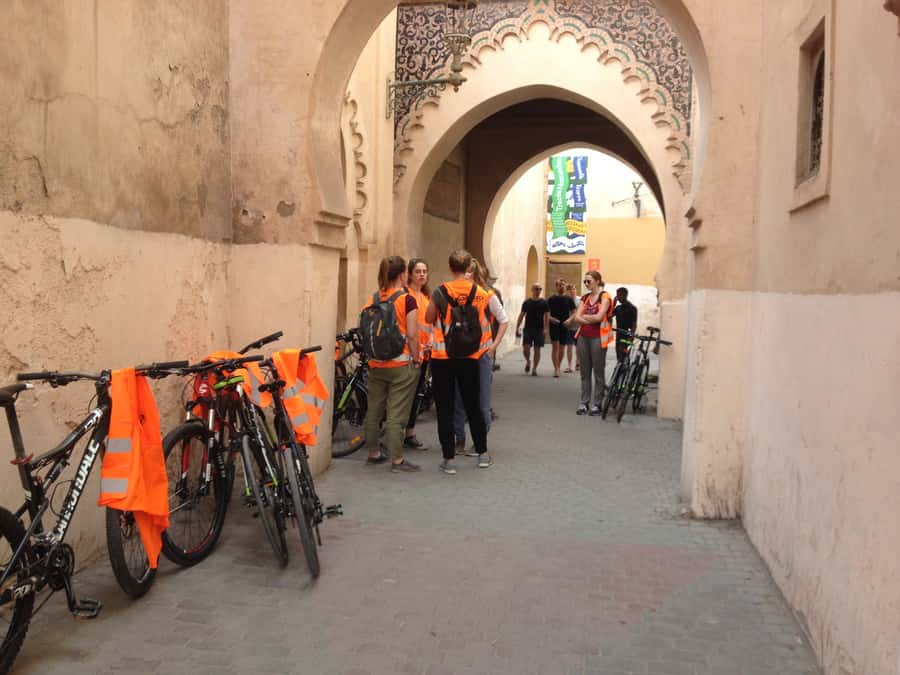
At $34 per person, this is a strong value if you want a broad introduction to Marrakech. Bike rental and a local guide are included, and the route covers much more ground than a short walking tour. You also get local orientation, photo stops, and the chance to see working parts of the city.
The price does not include monument entrance fees or drinks. That is reasonable for a city overview, but you should budget extra if you plan to enter the Saadian Tombs or Bahia Palace later. You may also want to buy a drink during or after the ride.
The main value is time. In three hours, you can see Gueliz, Hivernage, the Koutoubia area, Kasbah, the southern Medina, Jemaa el Fnaa, and several historic points. You do not get a deep visit at each sight, but you gain a useful map and a list of places for later.
Free cancellation up to 24 hours before the activity and the option to reserve now and pay later add flexibility. Starting times vary, so check the available departure when booking.
Who should book this Marrakech bike tour?
I would choose this tour if you are visiting Marrakech for the first time, want to cover old and new districts quickly, and enjoy a little controlled chaos. It is particularly useful on day one or day two, before you begin exploring the Medina alone.
It suits confident cyclists, couples, families with older children who can manage city riding, and anyone who prefers local streets to a standard sightseeing vehicle. One family found that an eight-year-old enjoyed the experience, but you should judge your own child’s confidence and attention carefully.
I would skip it if you dislike traffic, cannot ride comfortably for three hours, or want long, detailed visits inside each monument. A walking tour would be calmer for the Medina, while a private car would be easier for anyone concerned about road safety.
Final verdict: book it for orientation and local streets
Book this tour if you want to understand Marrakech quickly and do not mind riding through noisy, crowded streets. The best parts are the contrast between Gueliz and the Medina, the ride beside the red walls, and the small local encounters that happen between the major sights.
Choose an early departure when possible, stay close to the guide, bring water and a backpack, and ask about helmets before you leave the shop. If you can handle the traffic, $34 buys a useful first look at Marrakech and a much better sense of direction for the rest of your visit.
FAQ
How long does the Marrakech bicycle tour last?
The tour lasts three hours, including the guided cycling route and stops around Marrakech.
Where does the tour meet?
Meet your guide at the Morocco Toubkal Adventure shop. The listed starting location is 22 Rue Oum Errabia, Toubkal Adventure and biking in Marrakech.
Which parts of Marrakech does the route visit?
The route includes Gueliz, Hivernage, the Koutoubia Mosque area, the gardens behind it, the Kasbah, the Jewish Quarter, the Medina, the Saadian Tombs, Bahia Palace, and Jemaa el Fnaa.
Are entrance fees included?
No. Entrance fees for historic monuments are not included, so you pay separately if you return to enter places such as the Saadian Tombs or Bahia Palace.
What languages can the guides speak?
Guiding is available in Dutch, English, French, Spanish, and German.
Should I bring anything?
Bring water, a small backpack, and suitable clothing. The bicycles do not have baskets, and winter mornings can be chilly. Short skirts are not allowed.
Is the tour suitable for children or nervous cyclists?
The tour is only suitable for people who can ride a bike. Children may enjoy it if they are confident cyclists, but the Medina and city traffic can be intense. Stay close to the guide and tell them if you need a slower pace.
Just added around Marrakech
- Quad in the Palmeraie of Marrakech★ 5.0 · 41 reviews
- Marrakech Desert Camel Ride★ 5.0 · 17 reviews
- Sunset Camel Ride in the Palm Grove Of Marrakech★ 5.0 · 34 reviews
- Private Airport Transfer from or to Marrakech Menara Airport.★ 4.5 · 63 reviews
- Marrakech The History and Culture Day Trip★ 4.5 · 45 reviews
- Marrakech: Tailor-Made City Tour With Your Own Private Guide★ 4.9 · 236 reviews
- Marrakech palm grove: Sunset camel ride★ 4.8 · 194 reviews
- Sparkling Marrakech through the eyes of your local Guide★ 4.7 · 247 reviews
Guided, compared.
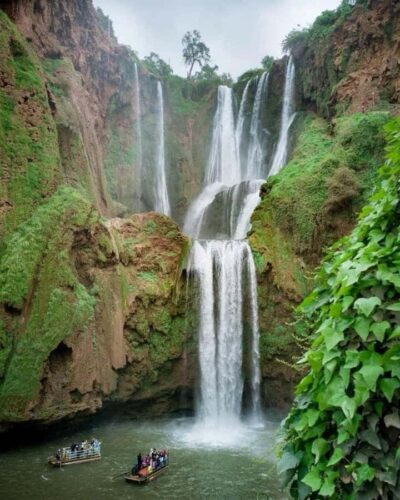
Ourika Waterfalls, Atlas Mountains, Guide + Lunch
Read our review →

Small group Ouzoud Waterfall Guided Tour Boat Ride from Marrakech
Read our review →