
Reviewed · CITY TOURS
Casablanca City Private Tour
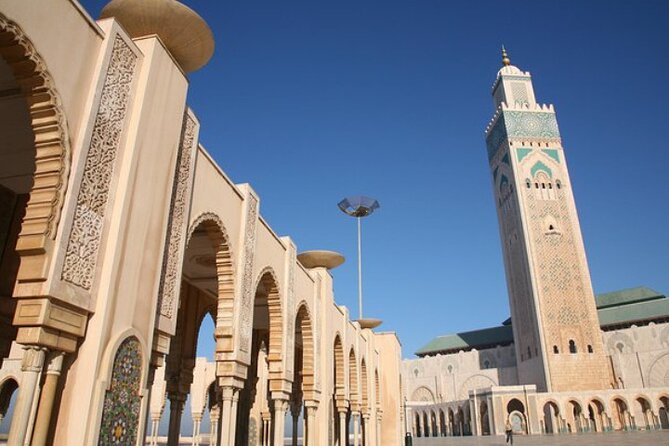
Casablanca’s great showpiece is the Hassan II Mosque, built beside the Atlantic with a 210-meter minaret and extraordinary tilework. This private tour gives you a useful first look at the city, then moves through its French-colonial squares, traditional markets, royal district, and old medina.
I like the private format, since your group can ask questions and adjust the pace. I also like the historical range: you move from Islamic architecture to Jewish heritage, French protectorate buildings, and everyday Moroccan life in a single half-day.
The main consideration is timing. Five hours is enough for a strong introduction, but not enough for a slow visit to every stop. Entry to Hassan II Mosque costs extra, and the tour is at its best when you reserve time for that interior visit.
Key points to know
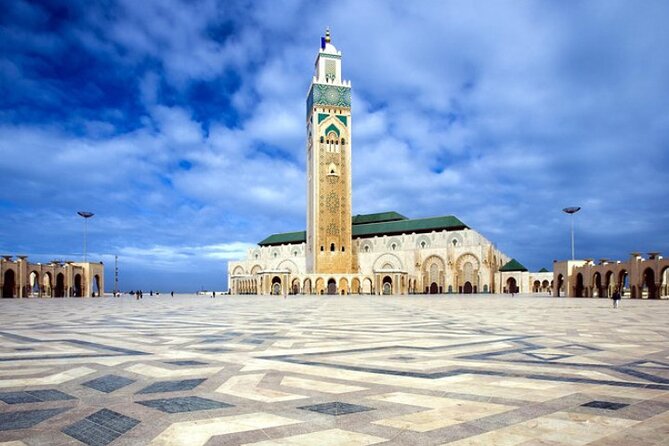
- Hassan II Mosque is the centerpiece: Allow 1 hour 15 minutes, plus the separate admission fee.
- Abdellatif and Abdel are praised guides: They are noted for clear English explanations and strong knowledge of architecture, religion, culture, and Casablanca’s past.
- The route covers five distinct areas: You see the mosque, Mohammed V Square, Habous, the Royal Palace area, and the Old Medina.
- The private vehicle saves time: An air-conditioned vehicle connects districts that would take longer to cover on foot.
- Local details add character: Mint tea, Moroccan sweets, tea-pouring customs, and discussions of Jewish heritage may be included depending on your guide and interests.
- The price works best for a group: The $174.22 rate covers up to 15 people, making the cost per person attractive when shared.
Starting with Casablanca’s Atlantic-side mosque
The Hassan II Mosque is the reason many people choose this tour. It is the largest functioning mosque in Africa, and its location beside the Atlantic gives the visit a strong sense of place. The minaret rises 210 meters, making it one of the city’s unmistakable landmarks.
Plan on about 1 hour 15 minutes here. You will see detailed tilework, carved surfaces, and careful craftsmanship that reward a slow look. The mosque’s scale can be hard to grasp from photographs, so having a guide explain its religious and architectural features adds real value.
Admission is not included in the tour price. That matters because the mosque is not simply a quick photo stop. If you want to enter, confirm the current ticket cost and visiting schedule before you set your plans. The tour description lists the mosque visit, but the entry ticket is separate.
The guide can also help you deal with the practical side of the stop. Abdellatif is specifically praised for getting a group through the mosque queues quickly, a useful advantage when your day is tied to a cruise departure, train, or hotel checkout.
I would put this stop first in the day whenever possible. It is the most important sight on the route, and it gives the rest of Casablanca a clear point of comparison. After seeing the mosque’s formal design and religious purpose, the city’s later mix of French, Moroccan, Jewish, and modern influences becomes easier to understand.
More City Tours in Casablanca
- Casablanca City Tour with Hassan II mosque ticket
★ 5.0 · 2,480 reviews - Casablanca: City Tour with Hassan II Mosque Entry Ticket
★ 4.6 · 1,137 reviews - Casablanca: Hassan II Mosque & City Highlights Tour
★ 4.5 · 573 reviews
Mohammed V Square and the city’s public face
Mohammed V Square takes about 30 minutes and costs nothing to visit. It is surrounded by important public buildings, including the Wilaya with its clock tower and the Courts of Justice, decorated with Moorish design.
This is a good place to notice how Casablanca combines Moroccan forms with French colonial planning. Look for arches, tilework, geometric decoration, and broad civic spaces rather than expecting one single architectural style.
The square also gives you a sense of modern Casablanca. The Grand Théâtre de Casablanca brings a contemporary presence to the area, sitting opposite older public buildings. That contrast helps explain the city better than a tour devoted only to monuments.
Thirty minutes is a sensible amount of time here. You can take photographs, hear the main historical explanation, and look at the surrounding buildings without letting one square consume the whole morning. If you enjoy architecture, ask your guide to point out details in the courthouse and Wilaya that are easy to miss from the vehicle.
Habous Quarter, Morocco in a slower key
The Habous Quarter, also called the New Medina, receives about 1 hour 15 minutes. It dates from the early years of the French protectorate, with development beginning in 1916. Unlike the older medina, Habous was planned with a more orderly street pattern while still using Moroccan forms, market lanes, arches, and traditional shops.
This is one of the most useful parts of the tour for understanding daily Casablanca. You can walk through narrow lanes, browse market stalls, and see how a neighborhood can feel both planned and traditional.
Keep your expectations practical. Habous is not a preserved medieval town. Its identity comes from the way French-era planning was adapted to Moroccan life. That makes it especially worthwhile for anyone interested in how Casablanca developed during the twentieth century.
The private setting helps here. You can ask about local customs, shopping, food, and the meaning of different architectural details without trying to keep up with a large group. Several accounts of this tour describe guides offering mint tea or local sweets, and one guide even demonstrated how to pour Moroccan tea. These small moments can make the neighborhood feel less like a photo stop.
Habous is also a useful place to discuss Casablanca’s Jewish community and the city’s different religious influences. Guides on this experience have explained how Jewish residents formed part of Moroccan society, and some tours have included synagogues, a Jewish museum, and a cemetery when arranged around that interest. Those extra sites are not listed as fixed stops here, so ask in advance rather than assuming they are included.
The Royal Palace area in Habous
The Royal Palace of Casablanca receives about 30 minutes and no separate admission fee is listed. The palace is in the Habous neighborhood and was built in the 1920s, using a design by Louis-Paul and Félix-Joseph Pertuzio. Garden planning is associated with Jean-Claude Nicolas Forestier.
This is a short exterior-oriented stop. You should not expect a palace interior visit, since the tour information does not include entry. The value comes from seeing the royal district and learning how it fits into Casablanca’s urban story.
The half-hour timing keeps the visit efficient. You can take in the setting, hear the background, and continue to the old medina without losing the best part of the afternoon. If royal buildings are a major interest, this stop may feel brief. If you want a broad introduction to the city, it is a useful pause between Habous and the older quarters.
A few more Casablanca days worth comparing
- From Marrakech: Casablanca Tour with Hassan II Mosque Visit
★ 4.7 · 4,756 reviews - Casablanca: Hassan II Mosque Premium Tour with Entry Ticket
★ 4.5 · 2,971 reviews - Casablanca Day Tour from Marrakech and Big Mosque Visit
★ 4.8 · 2,394 reviews - Private Tour of Casablanca with Hassan II Mosque Entry Ticket
★ 5.0 · 1,102 reviews
The Old Medina and Casablanca’s earlier story
The Old Medina gets the longest listed visit, about 1 hour 30 minutes. This is where you encounter older lanes, local shops, and the layers of Casablanca’s past in a more immediate way.
The area has a long and complicated story. The former settlement of Anfa was associated with Berber communities and later with the Almoravid dynasty. The Marinids strengthened the port’s connections in the fourteenth century. Portuguese forces destroyed the area in the late fifteenth century and later built a fortress on the coast. The Portuguese name Casa Branca, meaning White House, helped give Casablanca its modern name.
You do not need to memorize every dynasty to enjoy the medina. The point is to see that Casablanca was not created only by the French protectorate or by the twentieth-century port. Its story reaches through Berber kingdoms, Islamic dynasties, European military expansion, trade, and modern urban growth.
The medina is also where a guide can make the biggest practical difference. A private guide can explain what you are seeing, help you follow the route, and answer questions about local life. Guides such as Abdellatif have been singled out for showing less obvious corners of the city and for explaining its cultural influences in plain English.
Allow time to browse without rushing. The Old Medina can feel much more personal than the large public squares, but the streets are not arranged for easy sightseeing. Your guide’s route matters, and your group should agree on how much time you want for shopping, photographs, food, and historical explanation.
What the private vehicle adds
The tour includes an air-conditioned vehicle and pickup is offered. That is important in Casablanca because the five stops are spread across different parts of the city. The vehicle lets you cover more ground than a walking-only tour, while the stops give you time outside the car.
The private arrangement means only your group participates. For a couple, family, or small group of friends, this can make the day feel much less rigid. You can ask for more detail at the mosque, keep the square visit short, or spend longer in Habous if the markets catch your interest.
The published price is $174.22 per group of up to 15 people. For one or two people, that is not a bargain compared with a shared city tour. For a family or larger group, the calculation changes quickly. At six people, it works out to roughly $29 per person before the mosque ticket. At 10 people, it is about $17.42 per person.
That group pricing is the strongest value point. You are paying for a private vehicle and guide rather than a seat on a fixed large-group route. Coffee and tea are not included, and Hassan II Mosque admission is extra, so keep those costs separate when planning your budget.
The guide can shape the whole experience
The strongest part of this tour is the guide’s role. Abdellatif, also referred to as Abdel in some accounts, is praised for explaining Casablanca’s architecture, religion, culture, and past in English. He is also noted for patience, friendliness, and answering questions clearly.
That range matters because Casablanca is not a one-theme city. The mosque calls for an explanation of Islamic design. Mohammed V Square opens the door to French protectorate architecture. Habous shows planned Moroccan urban life. The medina brings in port history, trade, and older settlement patterns.
A good guide also helps connect formal history with ordinary customs. Mint tea, local sweets, the correct way to pour tea, and explanations of Jewish life in Morocco are the kind of details that turn a sightseeing route into a more rounded introduction.
Guide assignments can vary, so you should not assume Abdellatif will lead every departure. Still, the repeated mention of his name gives you a useful request to make when booking: ask if Abdellatif or Abdel is available, and state that you want an English-speaking guide with strong historical and cultural knowledge.
Who will get the most from this tour
I would recommend this experience if you have only half a day in Casablanca and want the main sights without arranging several separate taxis. It also suits cruise passengers, families, and groups who value a flexible pace.
Older family members may appreciate the air-conditioned vehicle and the mix of short walks with driving. One account specifically describes an 80-year-old participant enjoying the experience, though the supplied information does not provide a formal accessibility rating. If mobility is a concern, ask the operator about walking distances and surfaces before booking.
History and architecture fans will get the most from the mosque, Mohammed V Square, and the palace area. Shoppers and people interested in daily life will likely prefer Habous and the Old Medina.
I would be less likely to choose this tour if you want a slow, specialized visit to one subject. Five hours must cover five stops, so the experience gives you breadth rather than long, quiet time at each place. It is also not the right choice if you want mosque admission included in the headline price.
Timing, booking, and cancellation
The tour lasts approximately five hours, although the listed stop times add up to about five hours. Pickup is offered, and you receive a mobile ticket after booking confirmation.
The experience is private, and most people can participate according to the supplied booking information. The tour requires a minimum number of participants, so an operator cancellation for that reason results in an alternative date or experience, or a full refund.
You can cancel for a full refund up to 24 hours before the local start time. Cancellations or changes made within 24 hours are not accepted for a refund. That policy is reasonable, but I would avoid booking the tour too tightly against a flight or ship departure unless you have a generous time buffer.
Should you book the Casablanca City Private Tour?
Book it if you want an efficient first look at Casablanca with a private guide, air-conditioned transport, and a route that mixes major monuments with ordinary neighborhoods. The combination of Hassan II Mosque, Habous, the Old Medina, and the city’s civic architecture gives you a useful picture in one morning or afternoon.
The best value comes when several people share the $174.22 group price. Add the mosque admission to your budget, and ask for Abdellatif or Abdel if guide choice is possible. I would also ask whether your group can include Jewish heritage sites or tea and sweet-tasting stops, since those have been part of some customized outings but are not fixed in the listed route.
Skip it if you want a full-day exploration or a slow specialist tour. For a first introduction, though, this is a sensible way to get your bearings and see the parts of Casablanca that are hardest to connect on your own.
FAQ
How long is the Casablanca City Private Tour?
The tour lasts approximately five hours.
How much does the tour cost?
The price is $174.22 per group of up to 15 people.
Is the tour private?
Yes. Only your group participates in the activity.
Is hotel or other pickup available?
Pickup is offered.
Is transportation included?
An air-conditioned vehicle is included.
Is admission to Hassan II Mosque included?
No. The admission ticket to Hassan II Mosque is not included in the tour price.
Which sites are visited?
The route includes Hassan II Mosque, Mohammed V Square, the Habous Quarter, the Royal Palace of Casablanca, and the Old Medina.
Are coffee and tea included?
No. Coffee and tea are listed as not included, although some guide-led outings may offer local tea or sweets depending on the arrangement.
Can most people participate?
The tour information states that most people can participate.
What is the cancellation policy?
You can cancel at least 24 hours before the experience for a full refund. Cancellations or changes made less than 24 hours before the start time are not accepted for a refund.
Just added around Casablanca
- Exclusive tour of Casablanca with access to the Hassan II Mosque★ 5.0 · 205 reviews
- Your Private Casablanca Transfer★ 5.0 · 52 reviews
- Casablanca Airport Transfer from hotel in Casablanca★ 5.0 · 18 reviews
- 14 Days From Casablanca- Morocco Grand Tour★ 5.0 · 24 reviews
- Casablanca City Tour: Hassan II Mosque, Medina & Hidden Gems★ 4.5 · 38 reviews
- Marrakeck City tour from Casablanca all the day around trip★ 5.0 · 35 reviews
- Religious Casablanca: Private Spiritual Tour Including Hassan II Mosque Visit★ 5.0 · 33 reviews
- Casablanca Night Tour with Andalusian Dinner Show★ 4.5 · 25 reviews
City Tours, compared.
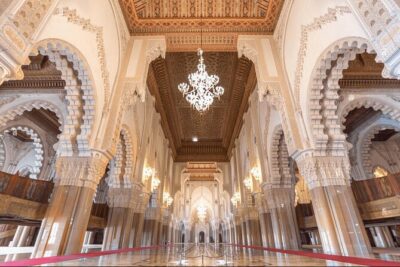
Casablanca City Tour with Hassan II mosque ticket
Read our review →
Kasbah, Souk, and Marina City Tour with Hotel Pickup
Read our review →
Casablanca City Night Tour and Traditional Moroccan Dinner
Read our review →

Browse the lists this tour appears in