Reviewed · MARRAKECH TOURS
Marrakech City Highlights Tour
Marrakech reveals itself best on foot, and this tour takes you from the city’s famous red-stone landmarks into the narrow lanes where daily life happens. You’ll see the Koutoubia Mosque, Bahia Palace, Bab Agnaou, the Mellah, and Jemaa el-Fnaa, with a local guide helping you make sense of the medina’s maze.
I like the mix of grand sights and ordinary places: the tiled rooms of Bahia Palace on one hand, small workshops and quiet courtyards on the other. I also like that guides such as Omar and Rashid have taken guests away from the busiest market lanes for a more local feel.
The main caution is guide-language coordination. The advertised tour is in English, and one booking with a requested Italian guide led to a long wait and weak language skills. Confirm your language before the day, and expect attraction entry fees to come separately.
Key points to know before you book
- The meeting point is beside Koutoubia Mosque, near the white dome on Avenue Mohamed 5.
- Bahia Palace, museums, and other sights charge separate entrance fees, so bring extra money beyond the $46 tour price.
- The souks are easier with a guide, especially if you want to reach artisan workshops and less touristy lanes.
- Jemaa el-Fnaa changes by time of day, with juice sellers and performers earlier, then food stalls and music later.
- Omar and Rashid receive especially strong praise for their friendliness, flexibility, and local knowledge.
- The tour ends where it begins, making it easy to continue exploring the central medina afterward.
Why this walking tour makes sense in Marrakech
Marrakech’s old city is not difficult because it lacks sights. It is difficult because the sights are packed into a maze of lanes, courtyards, market streets, gates, and dead ends. A first visit can easily become a pleasant but confusing wander.
This tour gives you a framework. You begin near Koutoubia Mosque, move toward the Kasbah and Bahia Palace, then work through the medina and souks before reaching Jemaa el-Fnaa. After the main square, the guide takes you into quieter parts of the old city.
At $46 per person, the price is reasonable if you want a guide for the full walking route and an introduction to several major places in one outing. It is less attractive if you mainly want independent time inside the palaces or prefer to move slowly at each landmark. Entrance tickets are not included, so the final cost depends on which attractions you enter.
This is a walking experience, not a sightseeing drive. Wear shoes suited to uneven streets, and be ready for a long stretch on foot. One person found the route longer than expected, while the time at Jemaa el-Fnaa felt short. That is useful advice: the tour covers a lot, but it is not designed for lingering at every stop.
A few more Marrakech days worth comparing
- Marrakech: Quad Bike Tour to Palm Oasis and Jbilat Desert
★ 4.8 · 11,831 reviews - Marrakesh: Majorelle Garden Entry Tickets
★ 4.5 · 9,651 reviews - Marrakech Quad Bike Experience: Desert and Palmeraie
★ 4.5 · 9,509 reviews
Starting beside the Koutoubia Mosque
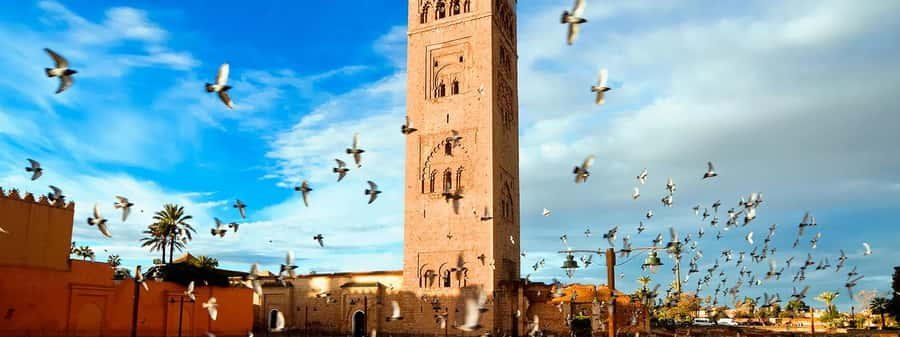
The meeting point is next to the white dome near the Koutoubia Minaret, on the Avenue Mohamed 5 side. This is a sensible place to begin because the mosque is one of Marrakech’s clearest landmarks and a useful reference point in a city where directions can quickly become confusing.
The Koutoubia is Marrakech’s largest mosque, and its minaret is one of the city’s defining sights. You will learn about its role in Moroccan religious and civic life, as well as the design features that make it so recognizable.
Entry to the mosque is restricted, so this is an exterior visit. That limitation is worth knowing before you arrive. The value here comes from the guide’s explanation and the chance to understand the building’s place in the city, not from walking through its prayer hall.
Take a moment to look at the surrounding streets before setting off. Koutoubia is one of the last easy landmarks you will have once you enter the medina. If you are meeting the guide on your own, arrive with time to spare and look for the white dome rather than relying only on a phone signal in the crowded center.
Bab Agnaou and the royal Kasbah
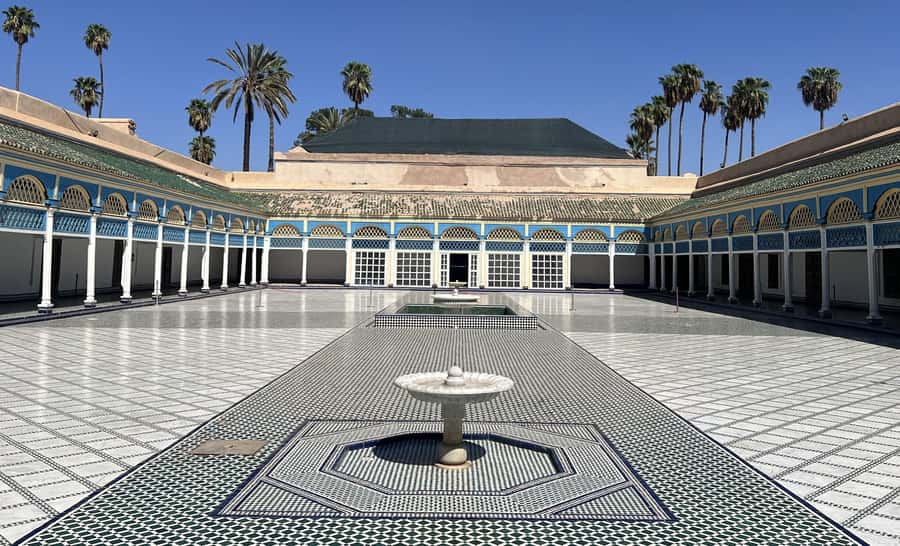
From Koutoubia, the route continues toward Bab Agnaou, a grand stone gate from the 12th century. Its carved decoration makes it more than a simple entrance. It served as a ceremonial gateway to the royal Kasbah, the fortified district connected with royal palaces and the Saadian Tombs.
This stop adds useful context to Marrakech’s old city. The medina was not simply a market district. It contained separate areas for royal power, worship, trade, crafts, and residential life. Bab Agnaou helps you see how those pieces fitted together.
The Kasbah is also a good place to pay attention to the difference between Marrakech’s major monuments and the streets between them. The gate is formal and heavily decorated. Nearby lanes can feel much more lived-in, with people moving through ordinary routines.
The Saadian Tombs are part of the wider Kasbah area, but attraction tickets are not included in the tour. Ask your guide what the walking route includes on your date and what you would need to visit separately. The itinerary gives you the historical setting, but you should not assume every site is included as an interior visit.
The Mellah and Marrakech’s Jewish past
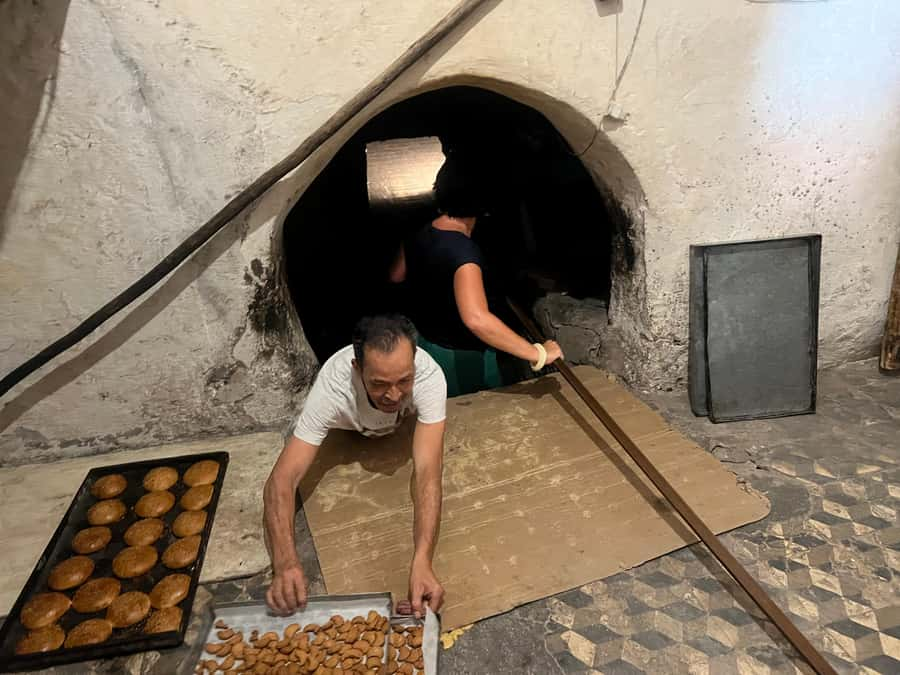
Near the Kasbah, the route reaches the Mellah, Marrakech’s historic Jewish quarter. Its narrow lanes, synagogues, spice sellers, and older buildings offer a different view of the city’s past.
This is one of the more worthwhile parts of the tour because it broadens the story beyond palaces and souks. Marrakech developed through contact between different communities, and the Mellah gives you a chance to see that part of the city in physical form.
The quarter is not presented as a separate museum-style stop. Instead, you explore its streets as part of the walking route. That makes your guide important. A good guide can point out details that you might pass without noticing, explain the area’s function, and connect it with the wider history of the medina.
If you are interested in architecture, watch for the contrast between the street fronts, inner courtyards, religious buildings, and market activity. The Mellah can feel more subdued than the main souks, which makes it a useful change of pace.
A completely different kind of day in Marrakech:
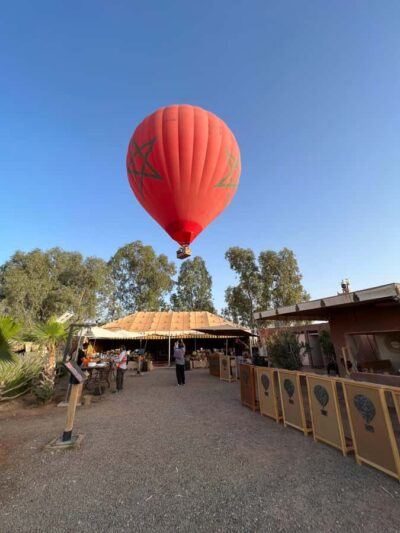
- Marrakech: Balloon Flight, Berber Breakfast & Certificate
★ 4.8 · 8,164 reviews - Marrakesh: Desert & Mountain Tour with Camel Ride & Lunch
★ 4.8 · 7,513 reviews - Marrakesh: Early Morning 40-Minute Balloon Flight
★ 4.8 · 6,533 reviews - Marrakech: Majorelle Garden, YSL, and Berber Museum Entry
★ 4.6 · 5,168 reviews
Bahia Palace’s tilework and painted ceilings
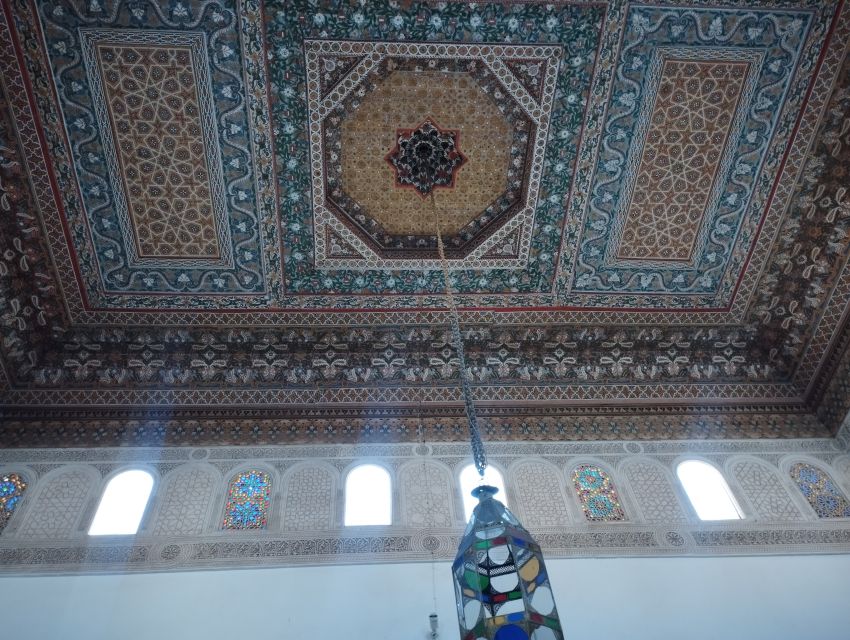
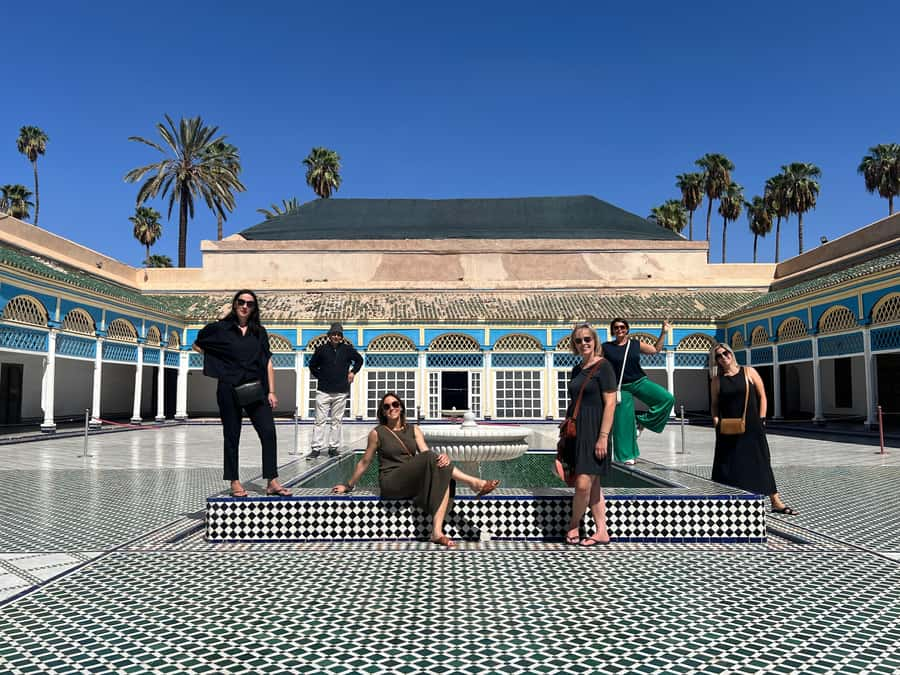
Bahia Palace is likely to be one of the tour’s visual highlights. This 19th-century royal residence is known for tiled floors, carved stucco, painted wooden ceilings, gardens, and carefully arranged rooms.
The palace is not a vast fortress with sweeping views. Its appeal is in the details and the way the rooms connect around courtyards and gardens. Look down at the zellige tilework, then up at the wood ceilings. The decoration rewards slow looking, even when the rooms are busy.
Your guide explains how the palace was built and how its spaces reflected the wealth and lifestyle of its former residents. That context helps. Without it, you may simply see a series of beautiful rooms. With it, you can better understand how Moroccan design combines geometry, carved plaster, painted wood, and water-centered garden spaces.
Entrance is extra, so budget for it if Bahia Palace is important to you. Also, keep your expectations realistic about time. A guided city tour needs to keep moving, and Bahia Palace is the sort of place where you may wish to stay longer than the schedule allows.
Entering the medina and its maze of souks
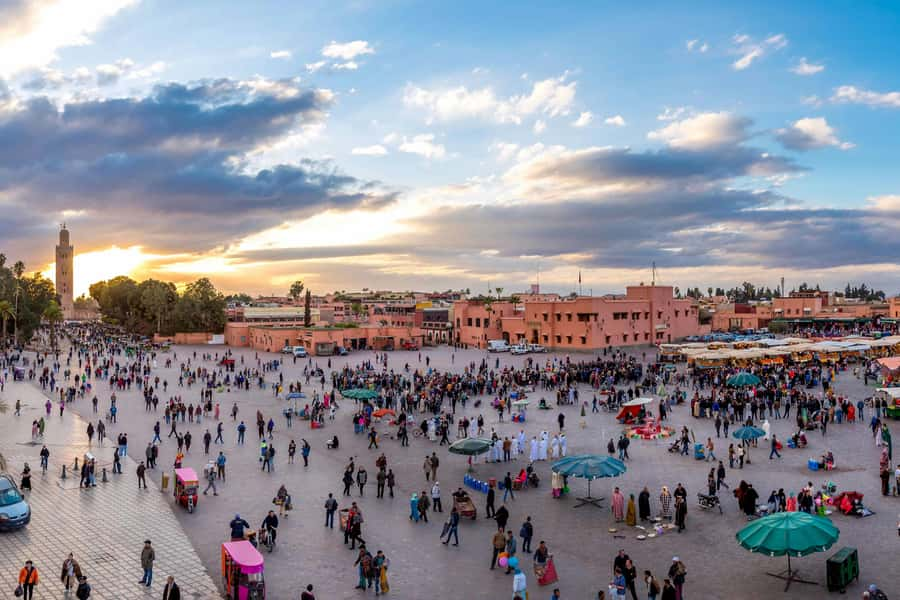
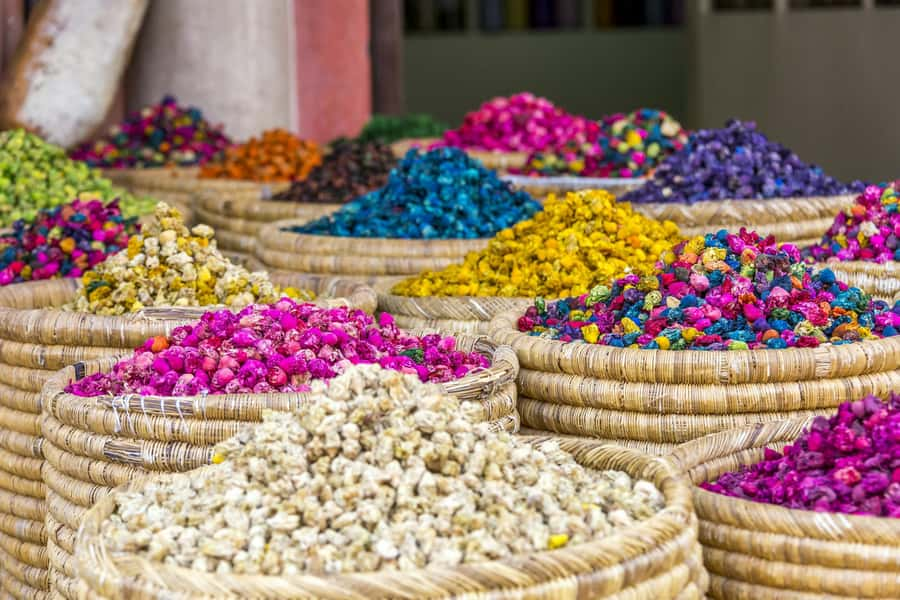
The medina and souks are where a local guide can make the largest practical difference. The streets twist through stalls selling spices, rugs, pottery, leather goods, and other crafts. It is easy to lose your bearings, and the most interesting workshops may not be on the most obvious route.
The guide explains how to bargain and helps you understand the rhythm of the market. That does not mean you need to buy anything. You can treat the souks as a working commercial district, watch artisans at their tasks, and decide later if something deserves space in your suitcase.
I would be clear with your guide about your shopping plans. If you want time for rugs, leather, or argan products, say so. If you do not want to shop, say that too. One German-language group was taken to a registered shop selling argan oil and similar products. Some people will appreciate the chance to buy with more confidence. Others may prefer to avoid commercial stops.
Rashid was praised for taking the group into less tourist-focused parts of the souks and for adapting when people had already visited places on the route. That kind of flexibility is valuable here. The medina works best when the route responds to what you have already seen, rather than forcing you through the same sights twice.
Jemaa el-Fnaa at its loudest
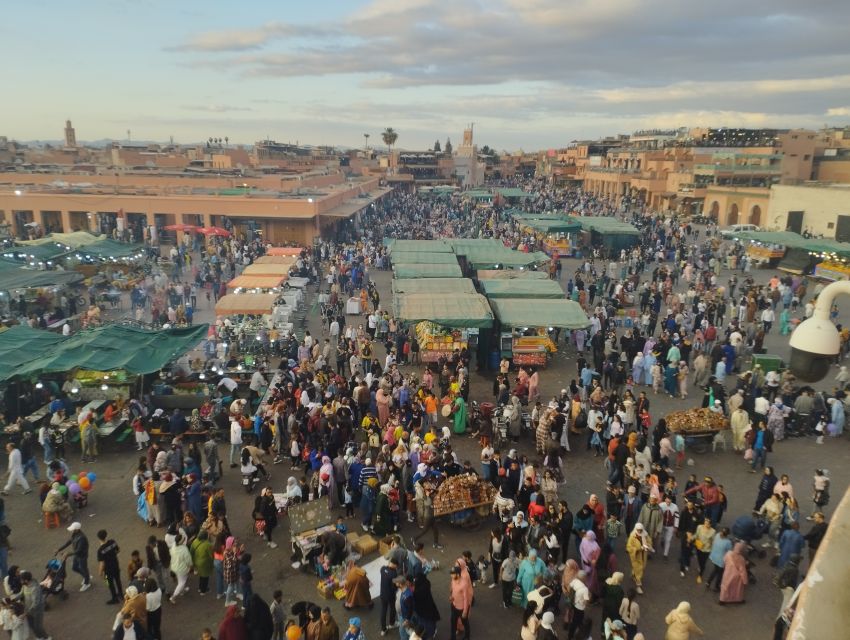
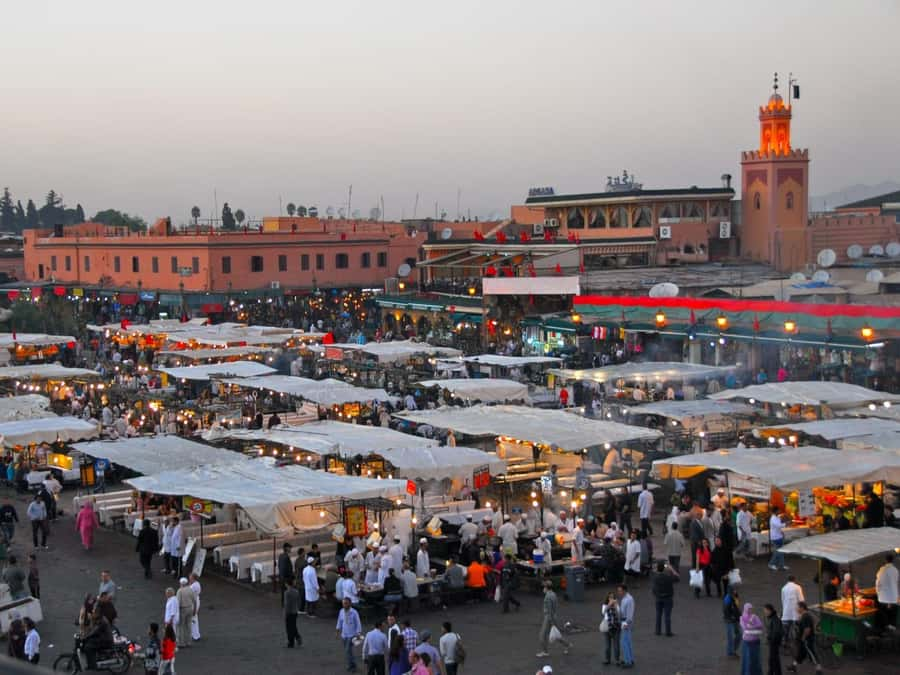
Jemaa el-Fnaa is Marrakech’s most famous public square, and it changes character as the day progresses. Earlier, you may find fresh orange juice sellers, performers, and snake charmers. Later, food stalls, musicians, dancers, and storytellers give the square a different energy.
The square is worth seeing even if you do not eat there. It is a public stage, a meeting place, and one of the clearest examples of Marrakech’s social life. Your guide can help you understand what you are seeing and how the square fits into the old city.
The drawback is time. The route gives you only a short visit here according to one experience, while the earlier walking sections can feel long. If Jemaa el-Fnaa is your main priority, ask at the start how much time will be spent in the square and consider returning independently afterward.
You should also keep personal belongings secure in crowded areas. That is ordinary city advice, but it matters more when you are watching performers, checking menus, and navigating through groups at the same time.
Quieter corners after the main square
After Jemaa el-Fnaa, the tour moves away from the famous center to local workshops, quiet courtyards, and historic riads. This is the part that can turn a standard sightseeing walk into a more personal look at Marrakech.
The quieter lanes show how much of the city is concealed behind plain doors and narrow passages. A riad may appear unremarkable from the street, then open into a decorated interior around a courtyard. Artisan workshops give you a closer look at the work behind the goods sold in the market.
This section also helps balance the major sights. Koutoubia, Bab Agnaou, Bahia Palace, and Jemaa el-Fnaa are essential stops, but they are also the places most likely to be crowded. The smaller streets offer a better sense of how residents use the medina beyond its headline attractions.
The quality of this section depends heavily on the guide. Omar was praised for being friendly and helpful, while Rashid was noted for his local insight and willingness to adjust the route. A German guide named Bouschta also received strong praise for handling a small group well. These details suggest that a good guide can make the less obvious stops worthwhile.
Optional calm at Le Jardin Secret
Le Jardin Secret can be added for those who want a quieter break in the middle of the medina. This restored Moroccan garden offers greenery, water, traditional design, and a calmer setting than the market streets outside.
It makes sense as an optional addition if you enjoy gardens and architecture, or if the pace of the souks becomes tiring. It also gives you another look at the importance of enclosed courtyards in Moroccan homes and palaces.
Because the visit is optional and entrance fees are not included, ask about the extra cost and available time before deciding. If you would rather spend that time in the markets or at Jemaa el-Fnaa, you may prefer to skip it.
Guides, group feel, and language
The experience is listed in English, and English-language guiding has been a strong point for some bookings. One guide was praised for speaking very good English, while Omar and Rashid were singled out for friendly, useful explanations.
Group size can vary. One small party of four had what felt like a private experience, which allowed the guide to adjust the route. That is a major advantage in the medina, where a small group can stop more easily and fit into narrow lanes.
Language handling deserves care. A German tour eventually had a German-speaking guide named Bouschta, but the language was not confirmed until the tour was close. An Italian booking had a more serious problem: the first guide did not speak Italian, the replacement arrived after a 30-minute wait, and the explanations were limited.
If English is fine, the booking is simpler. If you need German, Italian, or another language, confirm it directly and keep written proof of your request. The supplied information specifically lists English, so do not assume another language is guaranteed.
Meeting point, cost, and practical value
The tour costs $46 per person and includes a local guide, a bottle of water, and the walking route through the medina and souks. Transfers are not included unless requested separately. If you book a pickup, provide your accommodation name.
The tour begins and ends at the Koutoubia meeting point. For accommodation near the center, a private booking may allow the guide to meet you in the lobby. This is useful if you are staying close by, but confirm the arrangement rather than assuming it applies to every booking.
The price offers fair value if you want help finding your way, explanations at major sights, and access to artisan areas that can be hard to locate alone. It offers less value if you plan to enter several paid attractions and want extended time inside each one, since those tickets cost extra and the route covers many stops.
The tour has an overall rating of 4.5 out of 5 from 17 ratings. That is a good sign, but the mixed experiences on language and pacing matter more than the number alone. The best fit is a first-time visitor who wants orientation, local context, and a manageable introduction to the old city.
Should you book the Marrakech City Highlights Tour?
Book it if you want to understand Marrakech on foot rather than simply collect monument photos. The mix of Koutoubia, Bab Agnaou, the Mellah, Bahia Palace, souks, Jemaa el-Fnaa, and quieter medina lanes gives you a useful first look at the city.
I would especially recommend it for a first visit, for anyone uneasy about navigating the souks, and for visitors who want access to artisan workshops without wandering completely at random. Omar, Rashid, or Bouschta would be welcome guides based on the qualities noted above, though you may not be able to choose a specific person.
Skip it if you dislike walking, want to explore each palace at your own pace, or are mainly looking for a food tour. Also think twice if you need a language other than English and cannot get firm confirmation beforehand.
For most first-time visitors, the $46 fee is a sensible way to get your bearings. Just budget for entrance tickets, wear comfortable shoes, confirm the language, and return to Jemaa el-Fnaa later if the first visit feels too brief.
FAQ
Where does the Marrakech City Highlights Tour begin?
It begins beside the white dome near the Koutoubia Minaret, on the Avenue Mohamed 5 side.
Where does the tour end?
The activity ends back at the original meeting point near Koutoubia Mosque.
Is hotel pickup included?
No. Pickup transfer is available on request. If you book it, you need to provide your accommodation name.
Are attraction entrance fees included?
No. Entry to attractions is not included in the $46 price.
Is the tour offered in English?
English is listed as the tour language. If you request another language, confirm it before the tour because language arrangements have not always been clear.
Does the tour visit Bahia Palace?
Yes. The route includes Bahia Palace, with its gardens, tiled rooms, carved stucco, and painted wooden ceilings. Entrance is extra.
Is Le Jardin Secret part of the standard route?
Le Jardin Secret is optional. Ask about adding it and any separate entrance cost.
Can I reserve now and pay later?
Yes. You can reserve your place and pay later. Cancellation is available up to 24 hours in advance for a full refund.
Just added around Marrakech
- Quad in the Palmeraie of Marrakech★ 5.0 · 41 reviews
- Marrakech Desert Camel Ride★ 5.0 · 17 reviews
- Sunset Camel Ride in the Palm Grove Of Marrakech★ 5.0 · 34 reviews
- Private Airport Transfer from or to Marrakech Menara Airport.★ 4.5 · 63 reviews
- Marrakech The History and Culture Day Trip★ 4.5 · 45 reviews
- Marrakech: Tailor-Made City Tour With Your Own Private Guide★ 4.9 · 236 reviews
- Marrakech palm grove: Sunset camel ride★ 4.8 · 194 reviews
- Sparkling Marrakech through the eyes of your local Guide★ 4.7 · 247 reviews
Marrakech Tours, compared.

Quad Bike Tour to Palm Oasis and Jbilat Desert
Read our review →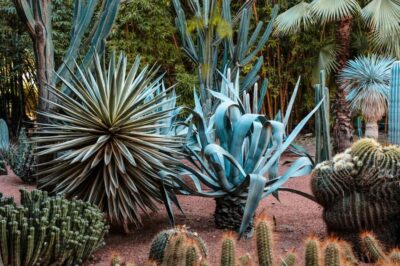
Balloon Flight, Berber Breakfast & Certificate
Read our review →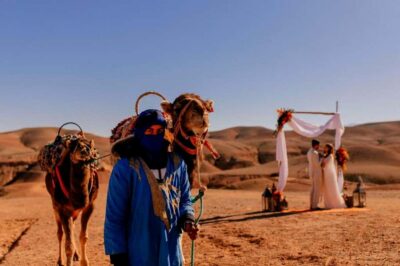
Desert & Mountain Tour with Camel Ride & Lunch
Read our review →
Dunes of the Palmeraie Quad Bike Ride with Tea
Read our review →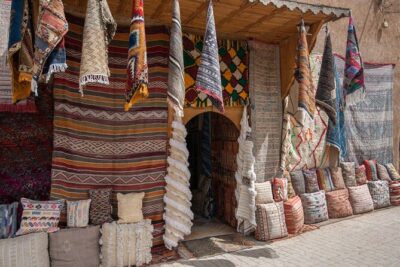
Bahia Palace, Saadian Tombs, Souk and Medina Tour
Read our review →